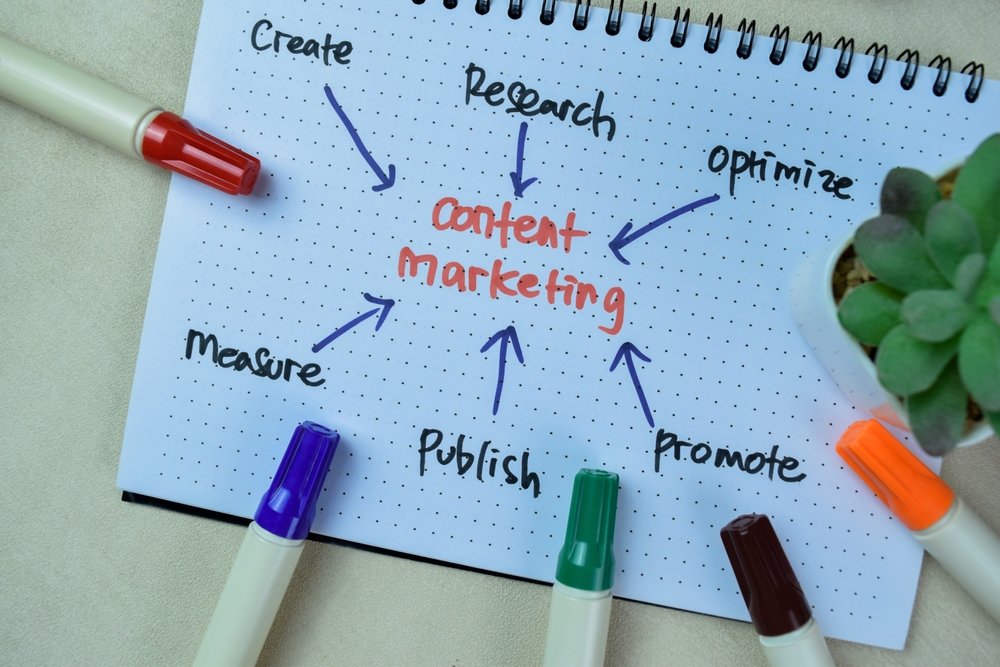
In the previous section, we discussed in detail Search Engine Optimization (SEO) to help you understand how SEO helps in driving traffic, gaining visibility, and generating leads organically. In this post, we are going to discuss the fundamentals of content marketing, its types, and why your business needs it.
SEO and Content are both woven into each other. In the digital world where your brand’s voice is lost somewhere in the noise, content marketing plays an important role in creating a buzz to attract and engage customers.
In this section, we will talk in detail about the content marketing definition, its types, strategy, importance, and much more. Let’s begin.
What is Content Marketing in Digital Marketing?
Content marketing is the process of producing and distributing content to educate, engage, and inspire the target audience. The aim is not to sell your product or service instantly, but rather to provide value to your audience, share valuable information, and update them unless they convert.
Unlike traditional marketing and advertising, the aim is to show customers how much you care and benefit them by offering products/services they need. However, there is no forced selling involved, rather educating, informing, engaging, and creating the desire.
Generally, content marketing is considered as writing blogs and publishing them for the sake of getting traffic. But the reality is something different. Keep on reading this long guide, as we have much to cover. So stay tuned.
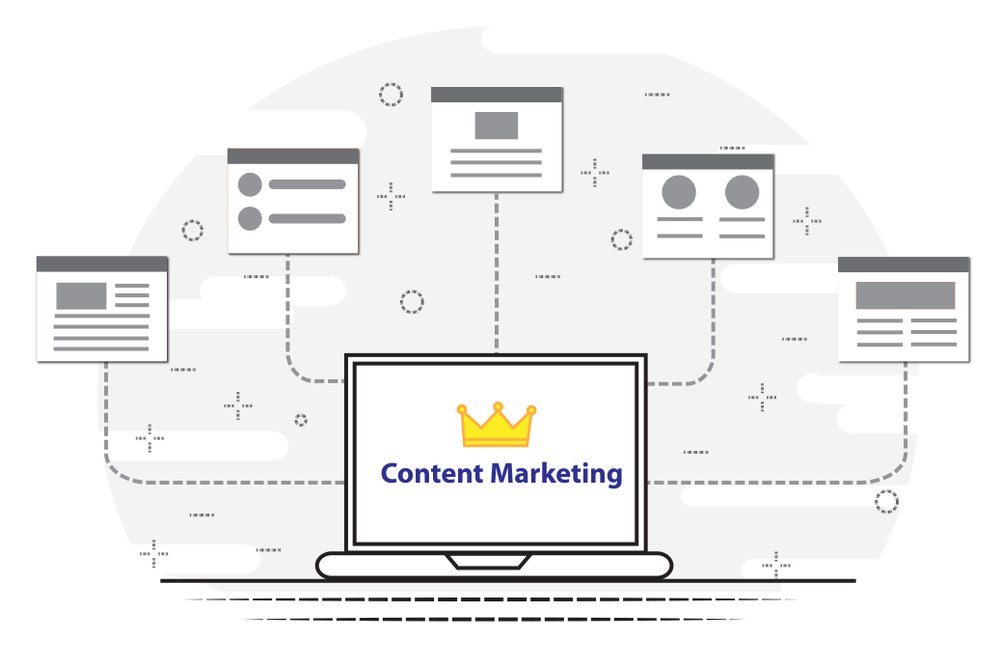
How does Content Marketing Work?
Content marketing is widely used by businesses to engage, attract, and convert visitors into customers. For instance, a person who is worried about soaring energy bills due to excessive use might be interested in buying a smart thermostat.
Instead of offering your product to the customer for buying, here’s a step-by-step approach to convert the lead into a paying customer.
Build Awareness
The first stage involves raising awareness among people who wish to cut down on their electricity bills. This step involves addressing the pain points of the target audience, which, in this case, is the soaring electricity bill.
The purpose of creating content for awareness is not to sell but to inform. For instance, you can ask the target audience what they are left with after paying their electricity bill. How can one save on electricity bills by installing a smart thermostat?
The content will develop some interest, and the audience might crave more to go into the next stage, i.e., consideration.
Consideration Stage for Customer
Now that you have engaged the customer who is worried about soaring bills. The next stage is to provide the customer with information and market the product. It can include content such as
- Benefits of installing a smart thermostat in the home to reduce bills
- Tips for buying a smart thermostat that actually reduces the bill.
- Best smart thermostats available on the market.
- Case study on how a single mom managed to reduce bills up to three digits
Closing Stage
Your content marketing effort has now become to convert the lead into a customer. The stage has arrived when you are going to softly push the sale and inform them how your smart thermostat is the best one to consider.
In the closing stage, you can write content like:
- Cost comparison of your smart thermostat vs others
- What features to look for in a smart thermostat (make sure they are included in your product)
- Why is your smart thermostat the preferred choice for customers? Testimonials in the video form
Why is Content Marketing Important for Businesses?
In today’s digital marketing era, every brand and business is going online. The noise is everywhere, but the melody is yet to be discovered.
Small businesses and startups have to do something really phenomenal to get their voices heard. There is no better option left than content marketing, which spreads across various online platforms and engages the audience.
Let’s take a brief look at why to use content marketing and its importance for small businesses and startups.
Builds Trust and Credibility: One of the benefits of content marketing for businesses and startups is that it helps in developing trust and credibility. From informing the audience with the right information to selling them the solution that addresses their pain point, content marketing can do miracles for small brands and startups.
Complement SEO and Enhance Brand Visibility: We discussed earlier how content and SEO are woven together. Content marketing plays an important role in improving rankings, driving traffic, and converting leads. Publishing high-quality content means constantly feeding information, convincing leads they need your product/ service, and letting them take action. However, the fact is that content marketing cannot work solely on its own and requires SEO to get the results.
Generates High Quality Leads: Every visitor engaging on your website means he/she is looking for a solution that addresses the pain point. It’s all in your hands how you take the charge and feed them with the right content they are looking for and distribute it across various mediums.
Analyze what type of content works the best, whether it is in the form of a video, an ebook, a whitepaper, or something else. Distributing the content and providing the right information will generate high-quality leads that might convert into customers.
Cost-Effectiveness: Content marketing is less costly and more effective than traditional marketing. The number of leads it can generate over time is endless. It is estimated that content marketing is 62% less costly than traditional outbound marketing.
Eases Customer Journey: From awareness to consideration and final sales, content marketing makes it easy for customers to make the decision, and also helps businesses to inform without doing it repeatedly.
Long-Term ROI: Compared to paid marketing, content marketing pays out for many years to come. Paid marketing only pays off as long as the budget allows small businesses and startups to do so. Once the budget is finished, paid marketing ends, and there is no other way than to invest more money to gain visibility and generate sales.
What Types of Content are Used in Content Marketing?
Content marketing isn’t limited to any specific type, such as text, video, or social media. In fact, it is the combination of all the formats that can be spread, promoted, and advertised to reach the target audience. However, in some cases, the content marketing is limited to a specific platform instead of all of them. Here are some of the types used in content marketing.
Blogs
Blogs are the most popular form of content marketing used by brands, small businesses, and startups. Generally, SEO optimized blogs are published on a brand’s website to gain traffic, engage customers, address the pain point, and give solutions.
Blogs, once published, can drive an insane amount of traffic and generate leads, provided that they are optimized with the right keywords. The effectiveness of blogs can be checked through the number of visitors it is driving.
Ebooks and Whitepapers
Whitepapers and ebooks are a long form of content that helps potential customers dive deep into the subject. Both of these forms of content are effective when it comes to B2B marketing. The gated content allows businesses to get the contact information of the user, as it can only be accessed by filling out the form.
Moreover, ebooks and whitepapers are highly beneficial in creating trust and credibility among users by developing authority in the subject.
Videos
Content marketing nowadays, without videos, is of no use. From product/service demonstration to creating an urge to buy, videos are highly engaging and effective in branding, advertising, and conversion. Nowadays, TikTok videos are being used to capture the attention of users without letting them lose interest due to short attention spans.
Infographics
Infographics are highly effective in spreading the word and creating an impact. The infographics can be edited in various ways, such as comparison, stats, facts, and general information. Brands that create infographics for their products/services likely build authority in their specific niche.
Social Media Posts
Social media posts are highly effective in creating brand awareness and spreading content. Social websites like Pinterest, LinkedIn, Instagram, Facebook, and TikTok are great for promoting different types of content.
For instance, TikTok videos can be highly effective in promoting e-commerce products. Whereas LinkedIn is great for professionals and reach b2b customers. Similarly, Instagram is best for promoting apparel, accessories, restaurants, and cafes.
Webinars and Online Events
In some instances, customers’ interactions lead to removing discrepancies and questions that keep people from taking action. Webinars and online events are an ideal way to engage with customers directly, address their pain points, and provide a demonstration to make them aware.
How Do You Measure Content Marketing Success (KPI)?
In the SEO section, we discussed how to measure the success of SEO through various factors. Some of the key KPIs for successful content marketing are similar to SEO. Here’s how you can measure metrics of content marketing success.
Website Traffic: The core KPI of content marketing success is website traffic. How many users are visiting your website and engaging with your content? It all depends on how well you rank on Google.
Engagement Rates: Engagement comprises sharing, liking, and commenting on your content. It offers you an insight into how well your content is written, how well it reached the right audience, and engaged with it.
Conversion Rates: The number of visitors who successfully completed the action.
Lead Generation: If you are looking for the success of your content marketing campaign, figure out how many leads your content has generated.
Return on Investment: How much you have spent against the output of your efforts will determine the success or failure of your content marketing.
What are Common Content Marketing Mistakes?
Content marketing without a doubt yields ROI for years to come. However, in some cases, businesses fail to figure out the mistakes that result in negative ROI instead of positive. Here are some of the key factors leading to the failure of content marketing. Make sure to avoid them at any cost.
Lack of Strategy and Plan
Content marketing is evolving at a rapid pace. Especially after the domination of AI in digital marketing, things are changing at a rapid pace. To get the best output from content marketing, make sure to clearly define your target audience, goals, and needs.
For instance, you should ask who we are addressing, what their problems are, and how our product/service can help them out.
Compromising Quality
The value of content is often compromised to prioritize quantity over quality. The result is the wastage of resources, the misleading of the audience, and the loss of their engagement. Make sure to produce high-quality content that is informative and engaging. Instead of focusing just on selling your services/ products or trying to produce content in quantity, make sure to focus on quality.
Overlooking SEO
SEO without content and vice versa might do more harm than good. Think of SEO as a means to spread the high-quality content across online platforms. If you believe overstuffing keywords will help you rank on top, you are absolutely wrong. Remember, without SEO, your valuable content might vanish somewhere in the noise.
Understanding Target Audience and Tone
Content marketing is all about understanding your target audience. Based on your audience, you need to decide which tone to choose to address them. For instance, if your target audience is B2C, you need to set a tone that is conversational, easy, and friendly.
Whereas for b2b target audience, you need to adopt a professional, knowledgeable, empathetic, and direct approach.
Inconsistency in Messaging and Branding
When your branding and messaging change from one place to another, it can confuse your audience and weaken your brand identity. One common content marketing mistake is not keeping a consistent voice across platforms. Using the same tone, message, and visual style everywhere helps people recognize your brand, builds trust over time, and makes your business stand out in a competitive moving industry.
How is AI Changing Content Marketing?
AI is completely changing how content marketing works. It helps businesses create ideas faster, write smarter content, and personalize messages for different audiences in minutes instead of days. From SEO optimization to predicting what users want to read next, AI makes content more relevant, more engaging, and more results-driven than ever before.
AI is also transforming how marketers understand their audience. It analyzes behavior, search patterns, and engagement data to reveal what people actually want to read, watch, or buy. AI tools help repurpose content across blogs, emails, and social media automatically, saving time while keeping messaging consistent.
It even improves performance by testing headlines, optimizing keywords, and predicting which content is most likely to convert, making content marketing smarter, faster, and far more effective.
Did You Know?
Dev Souls offers content marketing services to small businesses, startups, and storeowners.
Probably that’s not exciting for a majority of people.
The exciting part is that Dev Souls is offering a free domain and hosting for one year if you buy any of its WordPress website development plans.